On this page
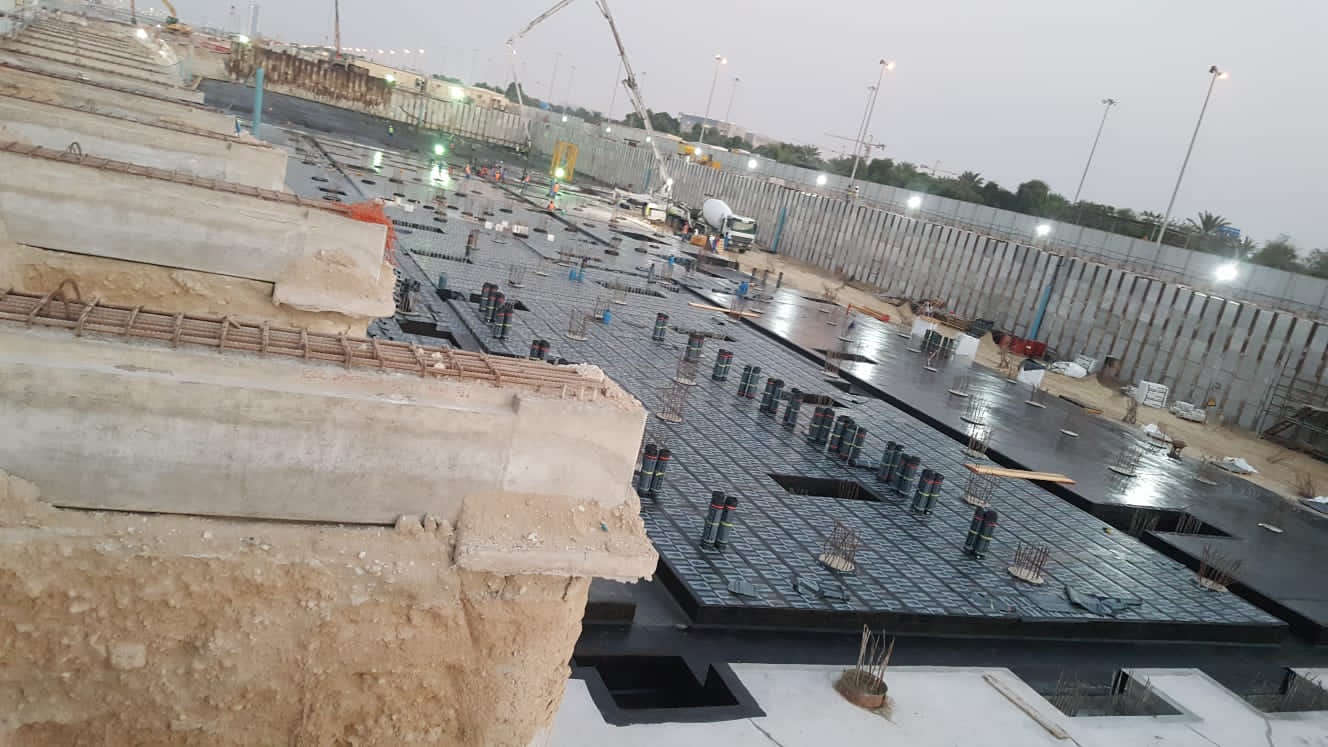
Selecting the correct waterproofing system for a project in the United Arab Emirates is rarely a question of cost alone. Substrate movement, surface temperature, exposure to UV and chemicals, project programme, and lifecycle expectations all shape the right choice. Two of the most common technologies considered today are hot-spray pure polyurea and torch-applied bituminous membranes. This article compares them across the criteria that actually drive performance in service.
Underlying chemistry
Pure polyurea is a plural-component elastomer formed by reacting an isocyanate with an amine-terminated resin blend. The reaction is extremely fast — gel time is measured in seconds — and the cured film is a continuous, seamless elastomer with very high elongation. Bituminous membranes are factory-manufactured sheets of oxidised or polymer-modified asphalt reinforced with polyester or fibreglass carriers; SBS and APP are the most common modifiers.
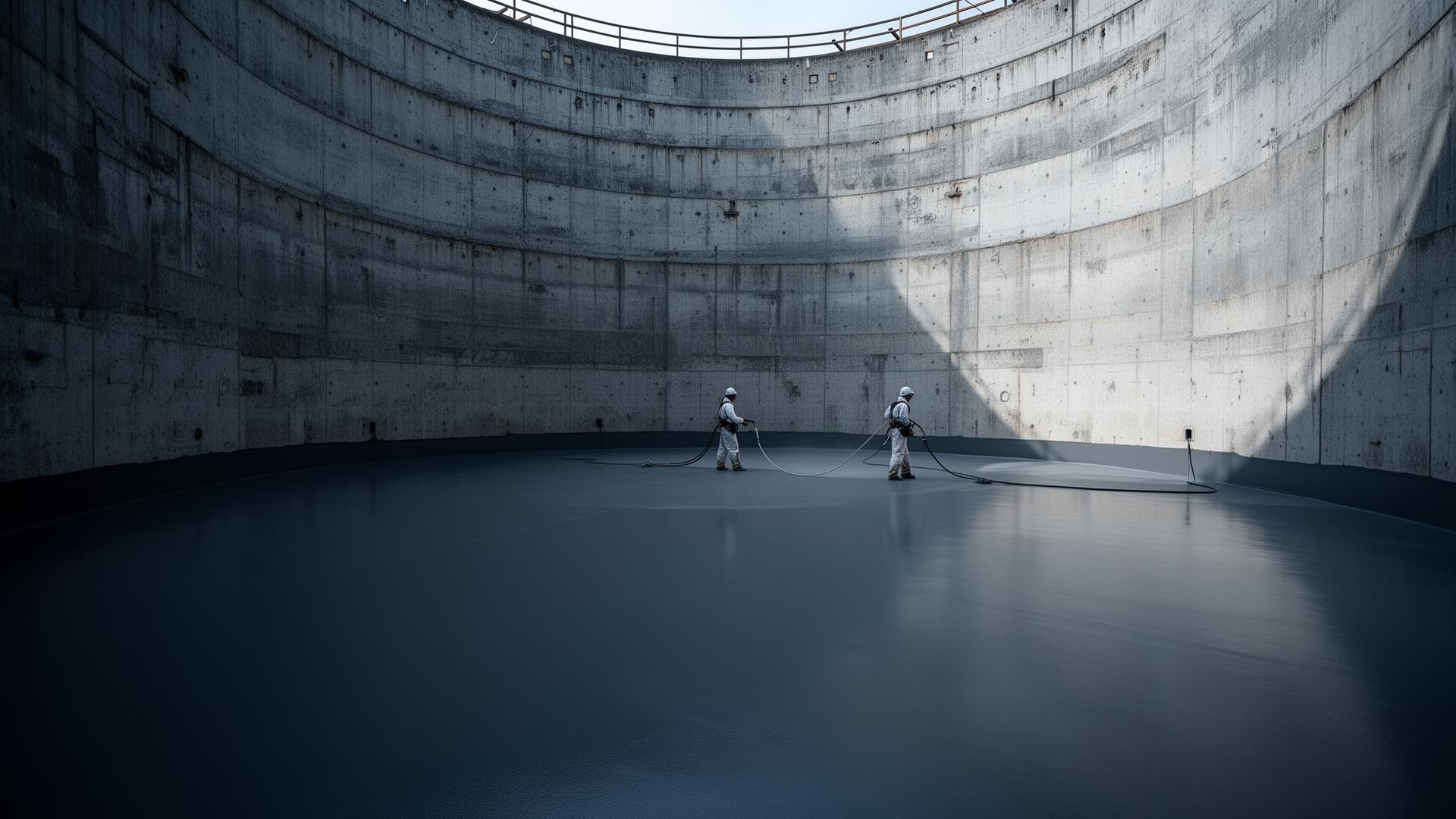
Hot-spray plural-component application
Pure polyurea is delivered through a heated 1:1 ratio plural-component rig at 70 °C and 2,000 psi. The seamless film cures behind the operator in under 15 seconds — a roof can be fully reinstated within a single shift.
Side-by-side comparison
- Pure Polyurea
- Liquid-applied, hot-spray
- Modified Bitumen Membrane
- Pre-formed sheet, torch-applied
- Pure Polyurea
- Tack-free in 5–15 seconds
- Modified Bitumen Membrane
- Hours to days for full set
- Pure Polyurea
- Seamless, monolithic
- Modified Bitumen Membrane
- Overlaps every 1 m sheet
- Pure Polyurea
- >800%
- Modified Bitumen Membrane
- 30–50%
- Pure Polyurea
- −40 °C to +120 °C
- Modified Bitumen Membrane
- −20 °C to +80 °C
- Pure Polyurea
- Excellent (aliphatic) / good (aromatic, when coated)
- Modified Bitumen Membrane
- Requires mineral cap or screed protection
- Pure Polyurea
- High
- Modified Bitumen Membrane
- Limited
- Pure Polyurea
- GRACO Reactor plural-component rig
- Modified Bitumen Membrane
- Open-flame torch
- Pure Polyurea
- Bridges dynamic cracks
- Modified Bitumen Membrane
- Limited; risk of split at laps
- Pure Polyurea
- 25+ years
- Modified Bitumen Membrane
- 10–15 years
- Pure Polyurea
- None (no open flame)
- Modified Bitumen Membrane
- High (open flame)
“On a 12,000 m² reservoir, every lap is a future leak. We removed laps from the equation by switching to seamless polyurea — and removed warranty calls with it.”
Application reality on UAE sites
Polyurea requires a clean, sound, dry substrate prepared by mechanical grinding or shot-blasting to achieve a CSP 3–5 profile and ICRI-acceptable cleanliness. Primer is applied to control outgassing on concrete, and the spray is applied in a single-pass build of typically 1.5–2.5 mm. The fast cure means a roof or tank lining can be returned to service within hours, which is decisive on phased infrastructure projects.
Bitumen membranes are faster to mobilise on small projects and accept less stringent substrate preparation, but they introduce a fire-watch requirement and depend entirely on lap integrity. In high ambient temperatures common in Abu Dhabi and Dubai, lap bonding and dimensional stability become critical control points.
- 01Diagnose
Condition survey, moisture mapping, and lift tests determine whether the existing system can be over-coated or must be stripped.
- 02Prepare
Mechanical grinding or shot-blasting to CSP 3–5; primer applied to control outgassing on concrete.
- 03Detail
Upstands, drains, and penetrations pre-detailed with reinforcement fabric in matched chemistry.
- 04Spray
Single-pass plural-component spray to a controlled WFT of 1.5–2.5 mm, continuously monitored.
- 05Test & hand-over
DFT verification by magnetic gauge, ASTM D4541 pull-off, and 48-hour flood test for horizontal areas.
When to choose which
- Infrastructure tanks, reservoirs, and tunnels: polyurea — seamless and chemically resistant.
- Bridge decks and parking decks: polyurea — bridges dynamic cracks and accepts traffic quickly.
- Simple flat roofs with no dynamic movement and short programme: bitumen can remain cost-competitive.
- Pile heads and complex geometry: polyurea — sheet membranes cannot detail intricate transitions reliably.
- Projects where any fire risk is unacceptable: polyurea — no open flame.
Combined 30+ years of polyurea and membrane application across UAE infrastructure, industrial, and commercial assets.